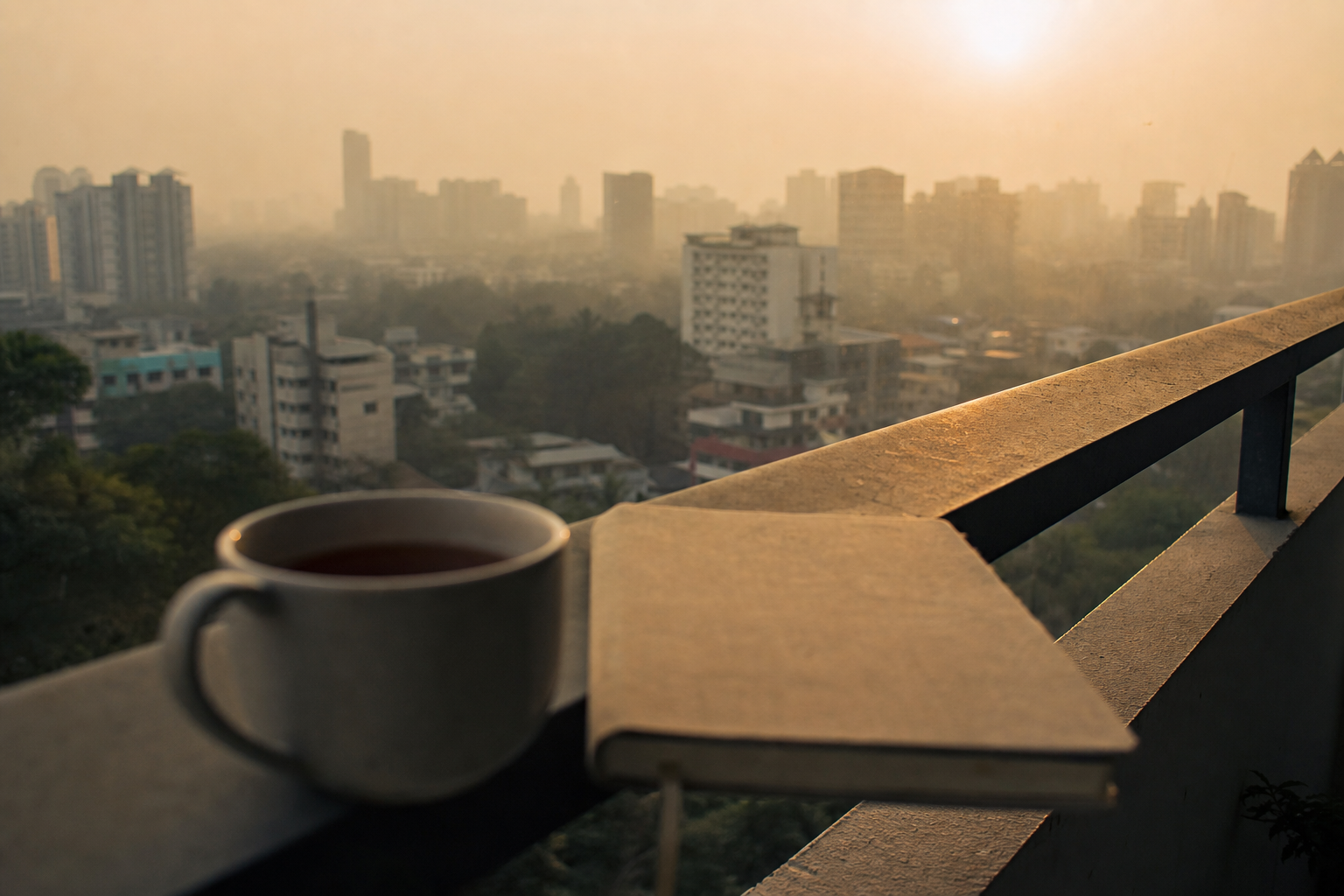
The rosacea trigger your diary misses: the day's air quality.
Cohort data links fine particulate pollution to rosacea flares, yet trigger lists still stop at diet, heat and alcohol. What to log alongside your photos instead.
The flare that tracked the sky, not the menu
Picture a rosacea diary kept faithfully for three months. Every glass of wine is in there. Every hot shower, every bowl of spicy noodles, every afternoon in the sun. The flares keep coming anyway, so the cutting starts: red wine first, then coffee, then the chili oil that was genuinely one of life's pleasures.
What the diary doesn't hold is a single line about the air. So the three worst weeks, which happened to line up with a run of orange and red days on the local air-quality map, get pinned on whatever was eaten that week. The diet takes the fall for the weather.
That patient is hypothetical. The gap isn't.
The smog-day blind spot
We call it the smog-day blind spot: a rosacea trigger with published epidemiological support that almost never shows up in the tools patients use to find their triggers.
The trigger is particulate matter, the tiny solid and liquid specks suspended in air from traffic exhaust, industry, construction dust and wildfire smoke. PM2.5 is the fine fraction, particles 2.5 micrometers across or smaller. For scale, the US EPA notes that an average human hair is about 30 times wider than the largest of them. Small enough to stay airborne for days. Small enough to settle into every pore on your face.
And it's measured constantly. Most cities publish readings every hour, free, on government sites and inside the weather app already on your phone. The data exists. The habit of writing it down doesn't.
Particulate matter, translated
PM10 is inhalable particles 10 micrometers or smaller (dust, pollen, mold fragments). PM2.5 is the fine subset, 2.5 micrometers or smaller, mostly from combustion: vehicles, power plants, wood burning and wildfire smoke. Both feed into the Air Quality Index your weather app shows. Source: US EPA.
Why 'diet, heat, alcohol' became the whole list
Most rosacea trigger lists grew out of patient surveys, like the one behind the National Rosacea Society's widely shared list NRS survey of 1,066 rosacea patients found the most common triggers; the published NRS trigger list does not include air pollution. ([source](http://www.rosacea.org/patients/rosacea-triggers/rosacea-triggers-survey)). Surveys reward triggers you can feel in the moment. A sip of hot coffee. The flush twenty minutes after a glass of Cabernet.
Particulate exposure has no taste and, on most days, no smell. Nobody self-reports a trigger they can't perceive, so it never climbs the list, so the next diary template leaves it out, so the next patient never thinks to check. The loop closes on itself.
There's a second problem. Hot, still summer days often trap pollution close to the ground. The same afternoon that logs as 'heat' may have been a high-PM day too, and heat, the trigger everyone already knows, gets all the credit.
Does air pollution cause rosacea flares? What the research shows
The clearest rosacea-specific signal comes from a Korean cohort analysis in the Journal of the American Academy of Dermatology (Li et al. Ma et al. (2024) conducted a nationwide population-based cohort study of over 21 million participants on AQI and rosacea risk ([source](https://www.ebsco.com/articles/consumer-health/9093800c-fba4-5eb2-8ed5-73b36530084e/association-between-air-quality-index-and-the-risk-of-rosacea-a-nationwide-population-based-cohort-study/))), which linked ambient PM2.5 and PM10 exposure to rosacea flares and severity Significant dose-response relationship found: each unit increase in AQI raised rosacea risk by 5% ([source](https://www.ebsco.com/articles/consumer-health/9093800c-fba4-5eb2-8ed5-73b36530084e/association-between-air-quality-index-and-the-risk-of-rosacea-a-nationwide-population-based-cohort-study/)).
The mechanism is plausible and reasonably well described for skin generally. Fine particles carry compounds like polycyclic aromatic hydrocarbons that drive oxidative stress, an excess of reactive molecules that damage cells, and they can weaken the skin barrier, the outer layer that keeps irritants out (Krutmann et al., J Dermatol Sci 2014 PM2.5 induces oxidative stress, inflammation, premature aging, and disruption of skin barrier function. ([source](https://pmc.ncbi.nlm.nih.gov/articles/PMC12927407/))). Germany's SALIA cohort separately tied traffic-related pollution to visible skin aging (Vierkötter et al., J Invest Dermatol 2010).
Two caveats belong right next to that. Population-level association doesn't prove pollution causes rosacea, or that it's your trigger specifically. And most of the mechanism work is general skin biology, not rosacea trials. What the literature does support is narrower and more useful: particulate exposure is a credible exacerbant worth ruling in or out for yourself.
AQI value
Category
Map color
0 to 50
Good
Green
51 to 100
Moderate
Yellow
101 to 150
Unhealthy for Sensitive Groups
Orange
151 to 200
Unhealthy
Red
201 to 300
Very Unhealthy
Purple
301 and higher
Hazardous
Maroon
The US Air Quality Index scale, the number worth logging each day. Source: US EPA AirNow.
Two weeks of logging, walked through
Here's the practical version. Each morning, or whenever you take your daily photo, read the AQI off AirNow (in the US) or your local environmental agency, and write down the number plus the pollutant it names as dominant. That's it. No new routine beyond ten seconds.
Then let the log run. One flare on an orange day proves nothing. But if the flares keep clustering on yellow-and-above days, while wine on a green day passes quietly, that's a pattern. Check the next day too, since skin doesn't always react on the same afternoon, and nobody yet knows the typical lag for an individual patient.
Wildfire season makes this sharper. A smoke week can push readings into red for days at a stretch, which is exactly when a diet-only diary would send you hunting for a food culprit that isn't there.
If redness is harder to see on your skin tone (Fitzpatrick IV to VI, the deeper end of the dermatology skin-type scale), log burning, stinging and tightness carefully. Sensory symptoms are real rosacea data, and they may be the clearest signal on a high-PM day.
Log field
What to record
Why it matters
AQI reading
The day's number, same time daily
Puts the air on the same timeline as your skin
Dominant pollutant
PM2.5, PM10 or ozone, as listed
Separates particulate days from other bad-air days
Time outdoors
Rough hours outside, commute included
Exposure depends on where you actually were
Daily photo
Same light, same angle
Evidence beats memory when you compare weeks
Sensory symptoms
Burning, stinging, tightness, eye irritation
Captures flares that don't read as visible redness
Other triggers
Alcohol, hot drinks, heat, sun, stress
Lets you see which variable actually moved
A minimal air-aware rosacea log. The first three rows are the ones most diaries are missing.
What changes if the blind spot is real
The biggest change is subtraction. Patients stop giving up foods and drinks they never needed to give up, because the log finally has the variable that was actually moving.
The dermatologist conversation improves too. 'I flare sometimes' is hard to act on. Eight weeks of photos lined up against AQI readings is something a clinician can look at in two minutes and respond to.
We're not suggesting anyone buy equipment or move cities. That's a separate decision, and one for you and your dermatologist. What we are saying is simple: the air-quality number belongs in every rosacea log as a standard column, as routine as the wine entry. Before you cut coffee, make sure the air wasn't the variable.
Before you cut coffee, make sure the air wasn't the variable.
Where Skinframe fits
Skinframe is built around photo-as-evidence: a daily photo next to per-feature symptom notes, so a flare shows up as a picture on a timeline rather than a vague memory from last Thursday. Skinframe lets users log any custom trigger via a free-text field, in addition to its built-in curated trigger categories; a user could log a daily air-quality reading (e.g. 'AQI 150') as one of these custom tags, though it stores it as a text label rather than a dedicated numeric field. Adding the day's AQI takes about as long as glancing at your weather app.
What you end up bringing to your appointment is a timeline with the air in it. Talk to your dermatologist before changing treatment based on any pattern you find. A log is evidence for that conversation, not a diagnosis.
What we're tracking next
We're watching for replication outside Korea, particularly in North American and European cohorts, and for any work that separates wildfire smoke from urban traffic pollution as a rosacea exacerbant. Ozone is the other open question, since it often spikes on the same hot days. When that research lands, this piece gets updated.
Start a rosacea log that has the air in it.
Skinframe is a rosacea tracker built on daily photos and per-feature symptom logging, from a team that reads the dermatology literature before adding a field. Evidence in adjacent conditions like atopic dermatitis and psoriasis shows patient-reported tracking improves visit outcomes; Skinframe applies the same approach to rosacea.