The rosacea flare your diary files as 'unknown cause'
Stress flares run on the same nerve pathway as a hot drink, but rosacea diaries have no field for them, so they corrupt every trigger you try to isolate.
The waiting-room flush you can't put on the list
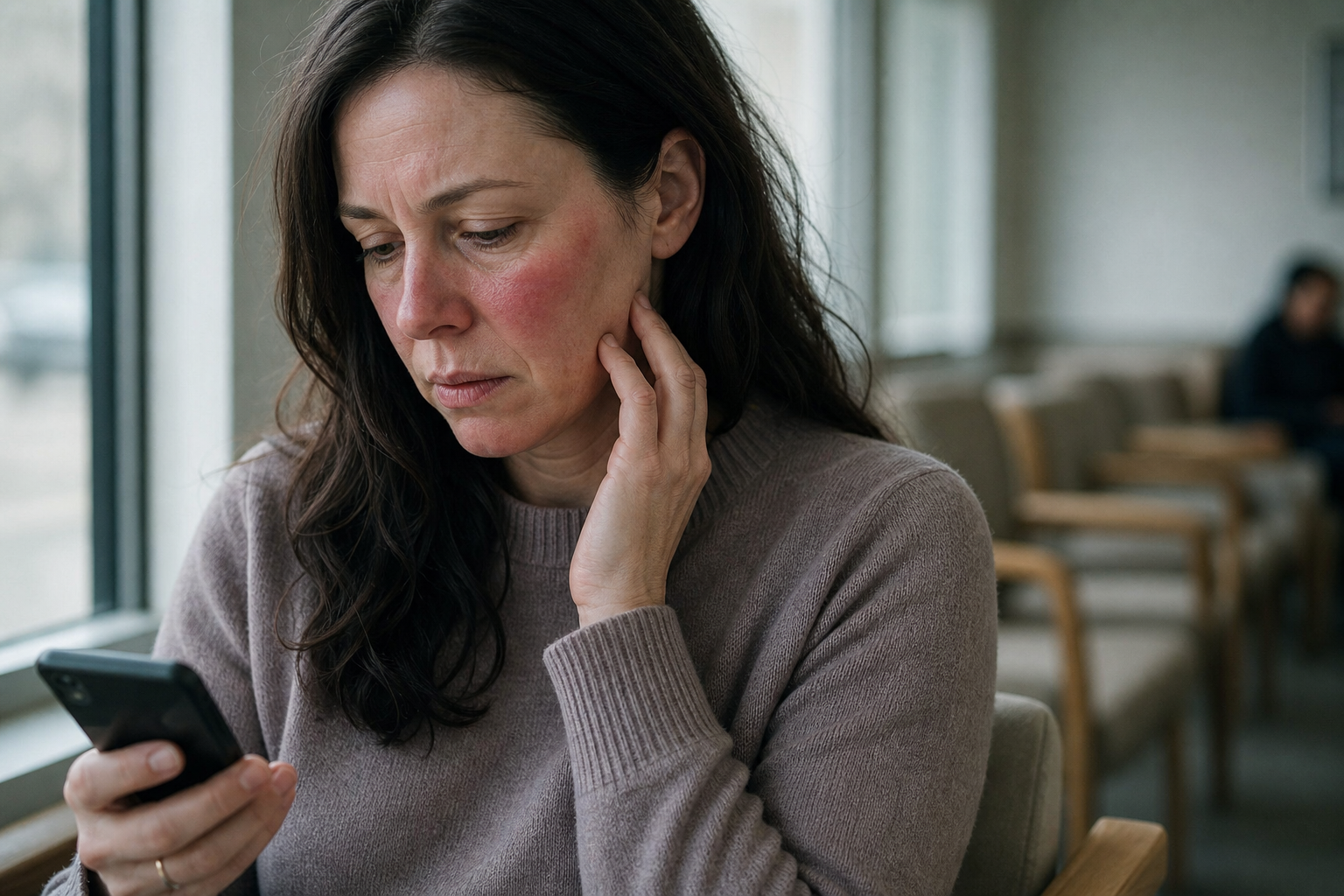
You rehearse the list on the drive over. Hot showers, red wine, the office afternoons when the heating kicks in too hard. Then you sit down across from the dermatologist, she asks where the redness is worst, and your cheeks answer before you do.
The flush arrives on cue, summoned by nothing on your list. It is the one trigger you cannot photograph in advance and cannot schedule: the act of being watched while you worry about being watched. By the time you leave, the most reliable flare of your week has gone undocumented, because no field on any rosacea diary, paper or digital, has a name for it.
The observer-effect flare
We call it the observer-effect flare, borrowed from the idea that measuring a thing can change it. Here the thing measuring and the thing changing are the same person.
The thesis is narrow on purpose. The psychological feedback loop in rosacea is not an open biology question. It is a data-capture gap. Stress-driven flares are real and mechanistically close to heat-driven ones, but the diaries built to isolate triggers carry no validated field for emotional state. So a stress flare gets filed under "unknown cause," and an unknown is not a neutral blank. It is noise that contaminates every clean comparison you make afterward.
Why "just manage your stress" is the wrong answer
Search "does stress cause rosacea flares" and the results agree on the verdict and the prescription: yes, and you should manage it. Breathing exercises, better sleep, less caffeine. The advice is reasonable. It is also answering a different question than the one a person mapping their own triggers is actually asking.
That reader is running an experiment on their own face. The useful question for them is not how to lower stress, it is how to log a stress flare so it stops poisoning the rest of the data. Lifestyle tips treat the emotion as a problem to fix. An elimination diary needs it treated as a variable to record. When every public answer skips the recording problem, the diaries inherit the same blind spot, and the reader is left with a log full of unexplained flares and no way to rule the real culprit in or out.
The same pathway as a hot drink
The mechanism is documented, and it is worth naming precisely. Under acute stress the body releases corticotropin-releasing hormone (CRH), the molecule that opens the stress axis. CRH degranulates mast cells in the skin, a link Theoharides and colleagues mapped in cutaneous tissue, and mast cells sit at the center of rosacea's inflammatory cascade. The mediators they release activate TRPV1, a heat-and-capsaicin sensor on sensory nerves that Sulk et al. (J Invest Dermatol, 2012) found over-expressed in rosacea-affected skin.
TRPV1 is the same channel a hot drink or a warm room trips. At the level of the nerve, a sauna and a difficult conversation are not easy to tell apart. Theoharides 1998 demonstrated CRH activates skin mast cells via CRHR1-dependent mechanism, leading to vasodilation and increased vascular permeability. ([source](https://pubmed.ncbi.nlm.nih.gov/9421440/))
The burden side is heavier still. Rosacea carries a well-documented psychiatric comorbidity load. Anxiety and depression rates in affected populations are consistently elevated, and the condition ranks among the skin diseases most strongly associated with psychological distress in the literature. That is the loop closing on itself: the flare causes distress, the distress runs the same neurogenic circuit as the original trigger, and the circuit produces another flare.
How one Tuesday corrupts a month of logging
Picture a Tuesday. A hard meeting runs long, the face goes hot by mid-afternoon, and the flare is photographed that evening. There was no wine, no sauna, no spicy lunch. The physical checklist comes up empty, so the entry is saved as "unknown cause."
Two weeks later the same person tries to isolate red wine. The data looks suggestive: several wine nights line up with flares. What the log cannot show is that three of those wine nights were also high-stress nights, the kind where a glass of wine was the response to the day, not the trigger of the skin. The stress and the wine are tangled, and the diary recorded only one of them. The verdict against red wine is now built on contaminated evidence. The n=1 method, the whole premise of self-tracking, breaks the moment the observer's state alters what is being observed and goes unrecorded.
What changes when the field exists
If the loop is a measurement problem, the fix is a measurement field. Capture emotional state beside each flare, even at the coarse level of calm, tense, or acutely stressed, and the unknown column starts to empty. Patterns that hid inside "unknown" become legible, and a trigger like red wine can finally be tested against a stress-free subset of entries instead of the muddled whole.
For readers with deeper skin tones, Fitzpatrick types IV to VI, recording state matters more, not less. Stress flares there often announce themselves as burning or stinging well before any visible redness appears, a sensory phenotype that photo-only logs miss. Adamson and Smith (JAMA Dermatology, 2018) and Daneshjou et al. (2022) documented how poorly automated, image-first dermatology tools perform on darker skin; a self-report field for what the flare felt like is part of how a log stays honest across every skin tone, instead of only the ones that flush an obvious red.
Why we built the field most diaries skip
Skinframe was built around this exact gap. Every flare entry pairs the photo with a quick emotional-state capture, kept on device, so a stressful Tuesday is recorded as what it was rather than dropped into the unknown pile where it quietly skews the next month of comparisons. We wrote separately about the single nerve pathway that heat, alcohol, and stress all share; this is the practical companion to that biology, the part the diary is supposed to catch and usually doesn't.
None of this is a diagnosis or a treatment. A clean log is evidence you bring to someone qualified to read it. If your flares keep coming back as "no obvious reason," that pattern is itself worth showing a dermatologist, and a record that includes how you felt, not only how you looked, gives them more to work with.
Log the emotional context beside every flare photo, on device, so a stressful day stops hiding inside your 'unknown' column. Start the trigger map with the field most diaries skip.
The stress-flare mechanism here is drawn from the same primary literature dermatologists cite: CRH-driven mast-cell degranulation and TRPV1 over-expression in rosacea skin (Sulk et al., 2012), plus the comorbidity cohorts that put rosacea's anxiety and depression rates near or above psoriasis. We don't diagnose and we don't sell a cure. We built a record that captures the variable every other diary leaves blank.