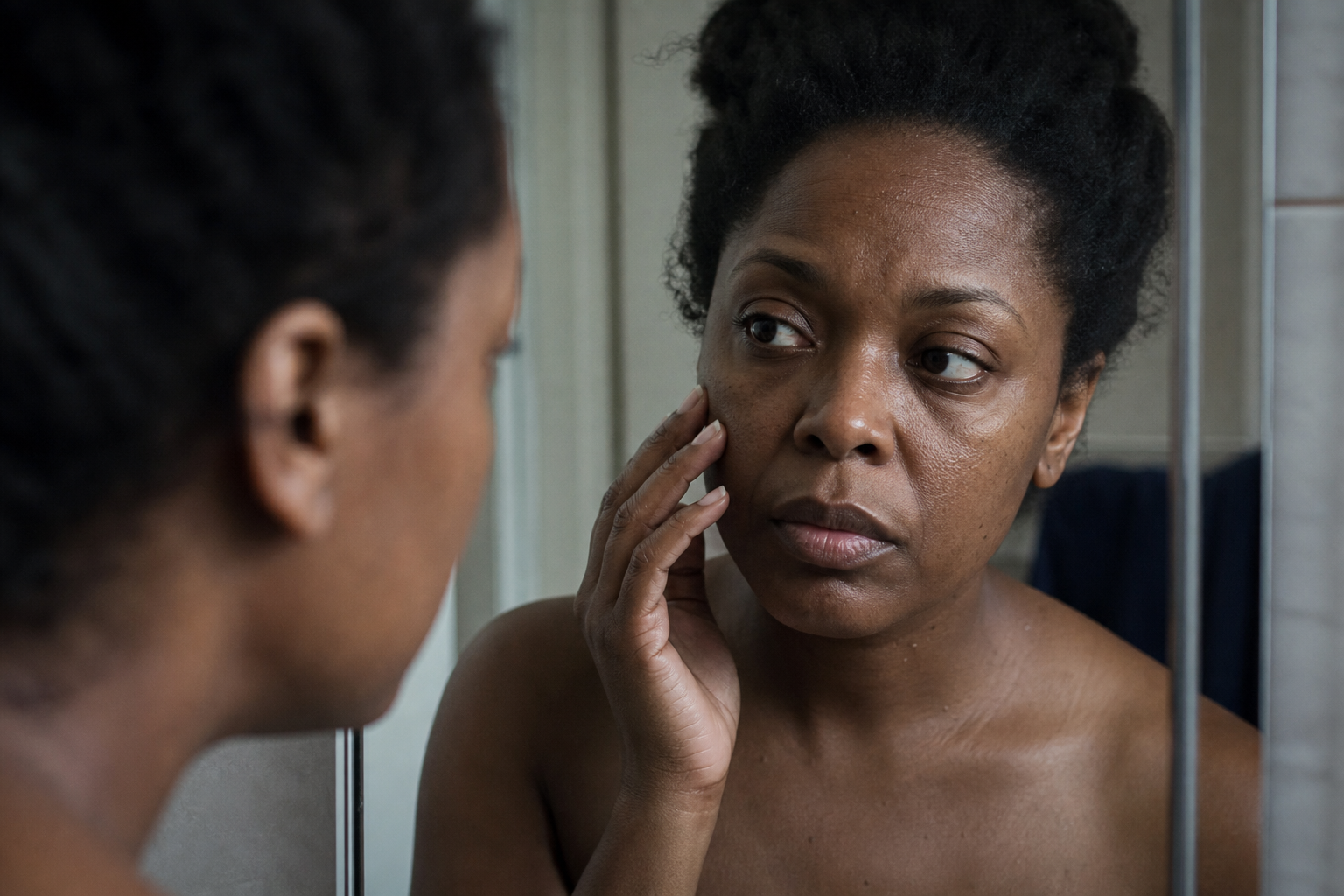
Rosacea has no subtype to find, only features to track.
Dermatology retired the four-subtype model in 2017. Here is why 'which subtype am I?' sends rosacea patients down the wrong path, and what to track instead.
The four-box answer comes from a framework dermatology retired
Type 'what subtype of rosacea do I have' into a search bar and the answer comes back in four tidy boxes: erythematotelangiectatic (redness and visible vessels), papulopustular (acne-like bumps), phymatous (thickened skin), and ocular (eye involvement). Pick the one that sounds like you. Most patient-facing pages still present these four buckets as the map of the condition. Dermatology stopped using that map in 2017. The boxes are everywhere in search results, but the people who write the diagnostic guidance moved on, and the gap between those two facts is where a lot of confused self-diagnosis now lives.
Why 'which subtype' is the wrong question
The subtype question carries a hidden assumption: that rosacea sorts each person into one category, and that finding your category tells you what you have. It does not work that way. The 2017 consensus reorganized rosacea around phenotypes, which is a clinical word for observable features, things like persistent redness, flushing episodes, bumps, and eye symptoms. The idea is small to say and large in practice. Stop asking which box you belong in. Start asking which features you actually have, and how often. Call it feature-tracking over subtype-typing. Once you see rosacea as a set of features that can appear in any combination, the single-label question stops making sense.
What the four-box model got wrong
The original four-subtype framework came from the National Rosacea Society in 2002 (Wilkin et al., JAAD 2002). It was a reasonable first pass, and even then its authors noted that patients could show features of more than one subtype. That caveat got lost. In patient-facing content the four labels hardened into mutually exclusive identities, as if you were one type and not the others. Real presentations rarely cooperate. Many people with rosacea carry features that span two or three of the old buckets at once, and those features come and go over time. A single label also implied a fixed identity or stage, when the features it described were never that stable. Collapsing a heterogeneous, shifting set of features into one noun is where the model broke.
What the 2017 consensus actually changed
Two groups arrived at the same conclusion in the same window. The global ROSacea COnsensus (ROSCO) panel published its recommendations in 2017 (Tan et al., British Journal of Dermatology 2017), and the National Rosacea Society Expert Committee issued its own update around the same time (Gallo et al., JAAD 2018). Both replaced subtypes with a phenotype approach. Under it, certain features are independently diagnostic on their own: persistent centrofacial redness (fixed redness across the central face) and phymatous changes (skin thickening) each count as rosacea by themselves. Other features, flushing, papules and pustules, telangiectasia (visible small surface vessels), and ocular symptoms, are recorded as present or absent and graded for severity rather than used to assign a type. One note matters for darker skin: persistent redness is the feature hardest to see on Fitzpatrick IV to VI skin tones, so the sensory phenotype, the burning, stinging, and dryness a person feels, often carries more of the signal there Centrofacial erythema and telangiectasia are less visually apparent in darker skin tones (Fitzpatrick IV–VI), partly because redness reads as a change relative to a person's own pigmented baseline rather than an absolute color, a dynamic that standard severity instruments, calibrated on lighter skin, can miss. The literature on rosacea in skin of color notes that sensory symptoms such as burning, stinging, and flushing episodes are often the most diagnostically reliable clues when the visual signal is masked..
What this looks like for one patient
Picture someone who has read the four boxes and decided she is 'erythematotelangiectatic, the redness one.' Her face flushes at wine and warm rooms, and there is a permanent pinkness across her cheeks. Under the bucket model, that is her type, full stop. So when a few small bumps show up along her nose every so often, she files them as something else, maybe ordinary breakouts, because bumps belong to the 'papulopustular' box and that is not her box. The feature view treats those bumps as their own line item: papules, present, low frequency, worth noting to a clinician. They may answer to a different trigger and a different treatment than her flushing does. The subtype label told her to ignore them. The feature record tells her to write them down.
Why feature-level tracking is the actionable version
Here is the payoff. A single subtype label collapses every feature into one bucket, which makes it impossible to tell which feature is reacting to which trigger. If 'rosacea' is one thing, all you can say is that it flared. If your redness, your flushing, and your papules are three separately tracked features, you can start to see that flushing lines up with hot drinks while papules do not, or that a given week's eye irritation tracked with something else entirely. The literature is honest that triggers are individual and not fully settled (the red-wine-versus-white-wine question, for one, is still unresolved per the NRS trigger surveys), so the value is not a universal trigger list. The value is a per-feature record specific to you that you can put in front of a dermatologist.
How we built Skinframe around features, not a label
We built Skinframe to match the 2017 framework rather than the marketing-friendly four boxes. The app logs each feature on its own, persistent redness, flushing, papules and pustules, skin thickening, ocular symptoms, with a photo as the evidence and severity recorded per feature instead of as a single composite score. That structure is not a product preference; it is what the consensus literature points to, since features tracked separately are the only way a trigger-to-feature pattern can surface. Everything stays on your device, because skin photos are sensitive and that is not negotiable for us. None of this is a diagnosis. If you are trying to answer 'what subtype do I have,' the better move is to stop sorting yourself into a box and start documenting the features you actually see and feel, then bring that record to a dermatologist who can classify and treat what is in front of them.
Skinframe is coming to iPhone. Join the waitlist and track your rosacea by feature, the way the 2017 consensus actually classifies it.
Skinframe was built to the 2017 ROSCO and National Rosacea Society phenotype framework, the same classification dermatologists use now, not the retired four-subtype model still floating around search results. Every feature is logged on its own, the photo is the evidence, and the record stays on your device.