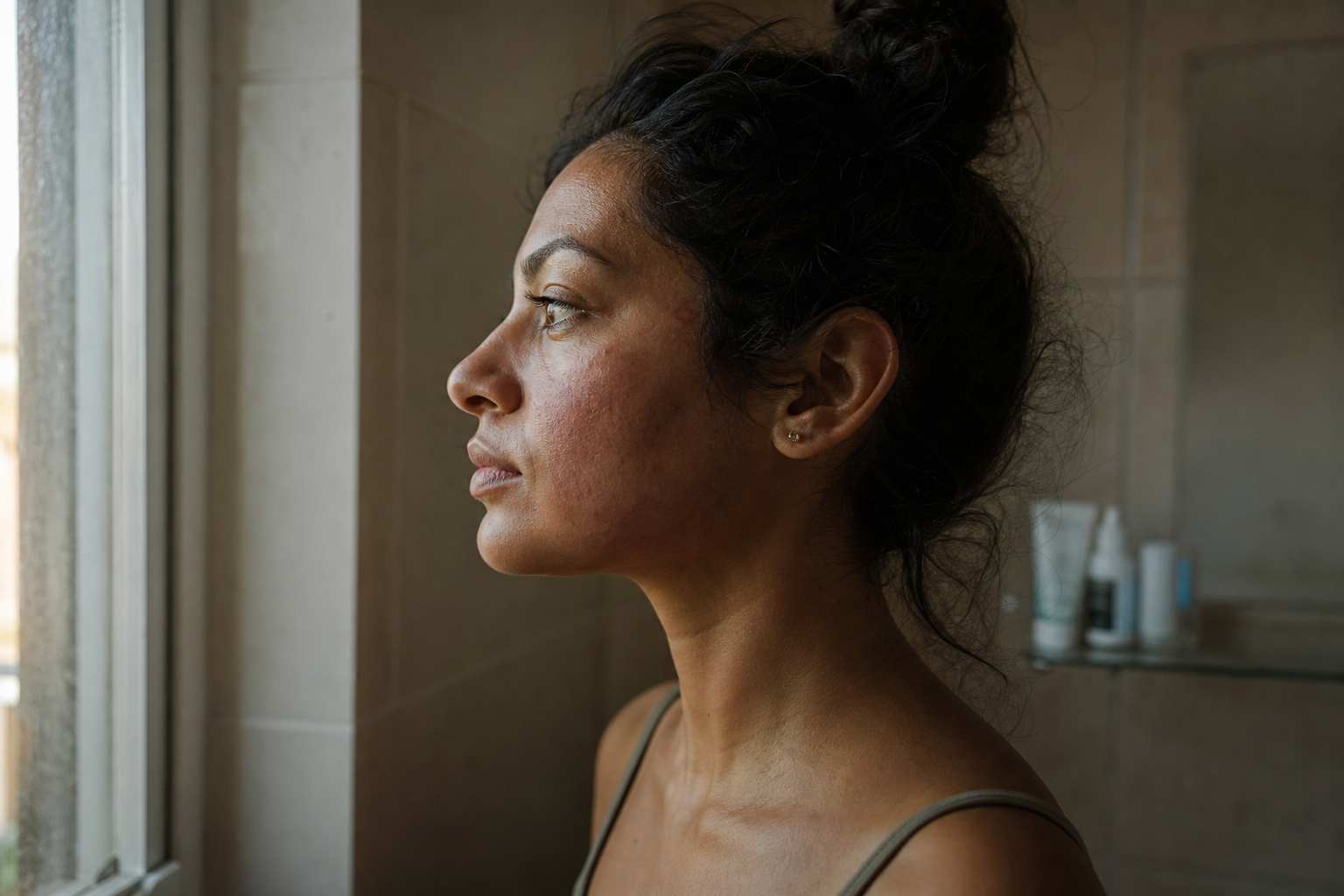
Your rosacea flares on a 28-day clock your trigger diary can't see.
Premenstrual rosacea flares look like random lifestyle triggers because most diaries never log the one variable that explains them: the day of your cycle.
The diary that explained nothing
Three months of entries, and almost nothing lined up. Red wine on the nights the redness came, true, but also on calmer nights when the skin stayed quiet. A hot shower one week. A bad Tuesday the next. A heat wave that should have set everything off and somehow didn't. The diary was careful. It was also nearly useless, because the column that would have made sense of it was never there: the day of the cycle each entry was written on. For a large share of premenopausal women with rosacea, the flares that read as random are running on a calendar the diary never opened.
The cycle-blind diary
Here is the pattern we keep seeing described in rosacea communities and clinic notes, and almost never logged: a flare that arrives in the back half of the cycle, roughly days 15 to 28, the stretch dermatology and gynecology both call the luteal phase. Estrogen climbs to a second, smaller peak after ovulation and then falls in the days before bleeding. That withdrawal, not any single drink or weather swing, is what a luteal flare tracks. We call the failure mode the cycle-blind diary: a log that is thorough about everything happening to your skin and silent about the one rhythm your body is keeping underneath it.
Why the trigger list can't catch this
Most rosacea advice runs on a same-day causation model. You flared, so something today did it: the espresso, the sun, the spicy bowl, the argument. That model works for the flares it was built for, the ones with a stimulus you can point at within hours. A hormonal flare breaks the model because it is timing-locked, not stimulus-locked. Nothing has to happen on the day it arrives. Estrogen falling on cue is the event. Hand someone a checklist of foods, weather, and stress and ask them to find a hormonal pattern in it, and they cannot, because the variable that explains the timing is not on the list.
What the literature actually supports
Hormonal change is not a fringe trigger. The National Rosacea Society has consistently included hormonal fluctuation among the flare factors its patient surveys track, and it shows up reliably enough to have earned a standing place in that list. The mechanism most often proposed is vascular: estrogen influences blood vessel tone and reactivity, and its withdrawal in the late luteal phase shifts the balance toward flushing, a response several reviews tie to prostaglandin-mediated vasodilation. Increased prostaglandin production in response to fluctuating estrogen levels during perimenopause is a known risk factor for rosacea. ([source](https://www.dermatologytimes.com/view/rosacea-and-menopause)). We want to be honest about the ceiling here: the within-cycle mechanism is supported and biologically coherent, not settled to the standard of a randomized trial. What is not in dispute is the timing. If flares cluster in one phase, the phase is the finding.
Cycle phase
Approx. days
Estrogen
What it means for flares
Menstruation
1 to 5
Low
Baseline; some report a flare as bleeding starts
Follicular
1 to 13
Rising
Vascular tone generally more stable
Ovulation
~14
Peaks, then drops
Short, sharp hormonal swing
Luteal
15 to 28
Second smaller rise, then falls
Late-luteal estrogen withdrawal is the classic flare window
Idealized 28-day cycle; actual day ranges vary per person. Standard reproductive physiology.
The pattern, walked through two cycles
Picture the same log with one column added. Cycle one: skin quiet through the first two weeks, a creeping warmth around day 18, full flush by day 24, settling as bleeding starts. Read alone, it looks like the heat wave that same week did it. Cycle two: different weather, different meals, no heat wave, and the warmth returns around day 19, the flush by day 25. Now the heat wave looks like a coincidence and the cycle day looks like the signal. One cycle proves nothing. Two cycles that rhyme are the whole case. The pattern does not live in any single day; it lives in the interval between them, which is exactly why a single day of triggers can never reveal it.
A pattern that takes two cycles to appear is invisible to a log that ends in two weeks.
A detection problem, not a treatment question
Here is what changes if the cycle is the signal. The problem stops being what to cut from your life and becomes whether you can see the rhythm at all. And seeing it has a hard floor: a hormonal pattern needs at least two full cycles to confirm, which is 56 days or more of unbroken logging. Most people abandon a trigger diary inside two weeks, well before the pattern can surface. The clinic cannot close the gap either. A fifteen-minute dermatology visit captures the skin in front of it; it does not routinely cross-reference flare history against menstrual timing, and the patient rarely arrives with two months of dated entries to make that cross-reference possible. The detection window and the documentation habit are the whole problem.
Two cycles minimum
A hormonal flare pattern needs two full cycles to confirm, roughly 56 days of unbroken logging. Most trigger diaries are abandoned inside two weeks, long before the pattern can appear. The logging habit is the bottleneck, not the biology.
Logging the variable that was missing
We built Skinframe around the gap this opens. A flare entry carries a photo and the day it happened, and cycle phase sits beside it as a first-class field rather than a note you forget to add. We are not predicting your flares or diagnosing anything. After two cycles, the timeline simply shows whether your flares cluster in one phase, in plain view, ready to bring to a dermatologist who would otherwise never see the overlay. On deeper skin tones, where a flush can register more as heat, burning, or stinging than as visible redness, logging the sensation matters as much as the photo. Everything stays on the device. We are giving you the column the diary was missing, and the patience to keep it for the 56 days it takes to matter.
What we are watching next
Two questions sit just past this one. The first is the opposite signal: why some people find their rosacea settles after menopause when estrogen stops swinging at all, which we cover in our piece on rosacea and the estrogen-protective hypothesis Skinframe's seventh editorial pillar covers the estrogen-protective hypothesis: why rosacea sometimes improves after menopause, how exogenous estrogen (MHT, OCP) is associated with increased incident rosacea risk, and how hormonal cycle phase functions as a real, trackable trigger. The pillar is positioned to reach perimenopausal women, an audience segment that mainstream dermatology content largely overlooks.. The second is how short a logging streak can get before the two-cycle pattern stops being trustworthy. Both end in the same place this one does: see the pattern first, then take it to someone who can act on it. If your flares run on a monthly clock, the next step is your dermatologist, with the dates in hand.
Track your flares with cycle day built in, and after two cycles, see for yourself whether yours run on a clock.
There is no rosacea-specific trial showing a tracking app changes outcomes, and we will not pretend otherwise. What the adjacent dermatology literature does show, in atopic dermatitis and psoriasis, is that structured patient-reported tracking improves what happens in the appointment A 2024 systematic review and meta-analysis of 1,038 patients found that mobile self-management apps for atopic dermatitis produced clinically meaningful reductions in symptom severity, with quality-of-life scores improving alongside; the broader dermatology literature (JAAD 2022) frames patient-reported outcome measures as a 'vital sign' that improves clinician-patient communication and visit efficiency.. Skinframe applies that same approach to rosacea, with cycle day in the record so a hormonal pattern has somewhere to show up.