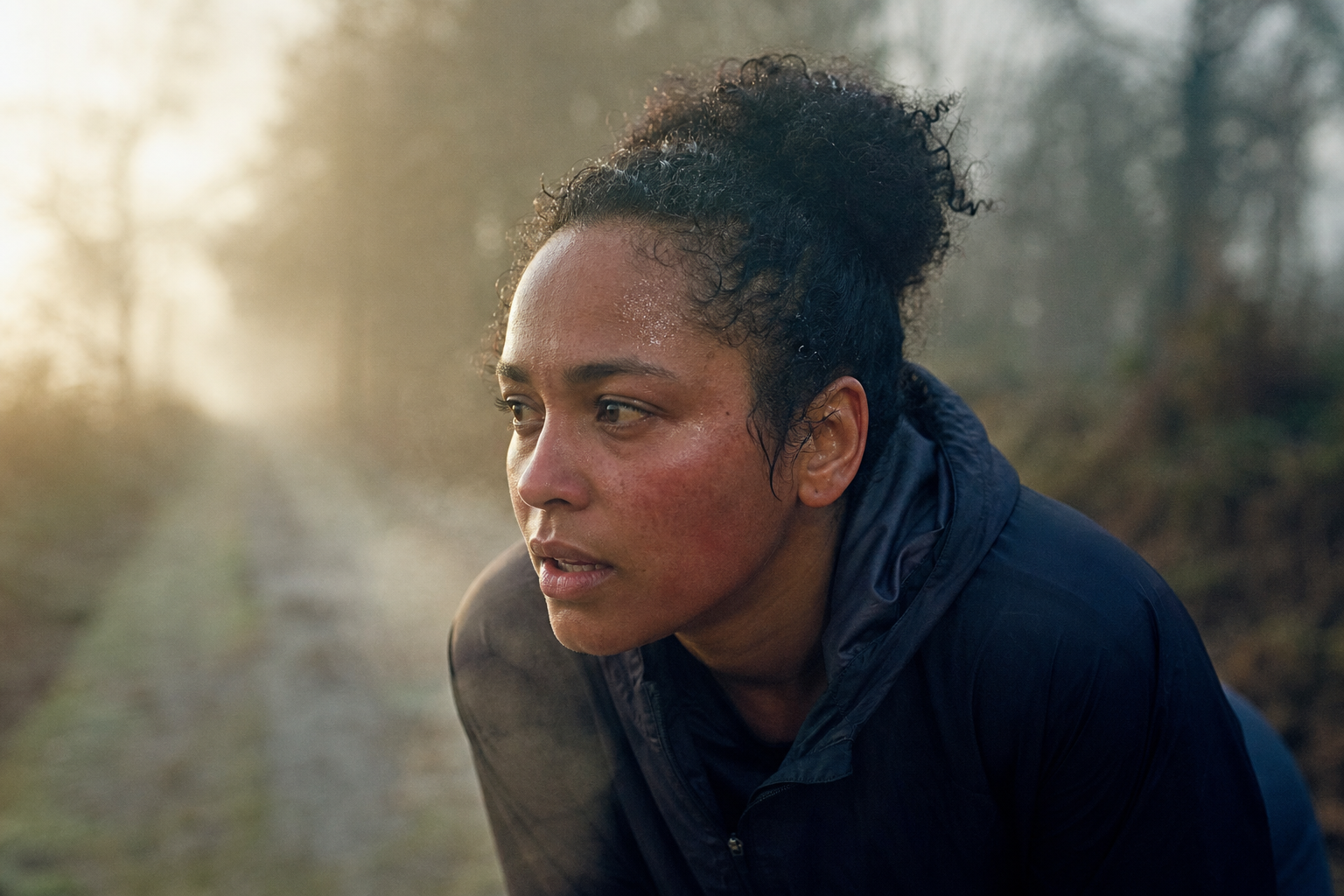
Your rosacea trigger isn't the workout. It's the core-temperature spike you can control.
Heat and heavy exercise trigger rosacea through one mechanism: thermoregulatory vasodilation. That makes ambient temperature, time of day, and exercise type tunable variables, not a binary you must avoid.
The run did everything right, and the face still flushed
Mile two of a morning run, and the warmth starts in the cheeks before the legs even feel it. By the time you stop, the flush has spread across the nose and chin, and it holds for the better part of an hour. You hydrated. You paced yourself. You ran in cooler air. The redness arrived anyway, and somewhere a wellness blog is telling you that people with rosacea should just exercise less.
That advice creates a real conflict. Cardiovascular exercise is not optional for long-term health, and being told it triggers your skin leaves you choosing between your heart and your face. Most rosacea content stops at that shrug. We think the shrug is hiding a much more useful answer.
The thermostat problem, not the treadmill problem
Exercise and heat sit in the same column of every rosacea trigger survey for a reason. They reach your face through one shared pathway. When your core temperature rises, your body sheds that heat by widening the blood vessels near the skin, a process called thermoregulatory vasodilation. In rosacea-prone skin, those facial vessels are already hyper-reactive, so the flush arrives faster and lingers longer.
We call this the thermostat problem, not the treadmill problem. The treadmill is incidental. A noon run, a hot yoga room, a sauna, and a heated commute all pull the same lever. Once you read exercise as one input into core temperature rather than a category unto itself, the variables that actually matter come into focus: ambient temperature, humidity, time of day, and how hard you push.
Why 'just exercise less' is the wrong answer
Blanket avoidance fails on two counts. The first is medical. Telling a rosacea patient to cut exercise trades a visible, manageable skin response for elevated cardiovascular risk, and no dermatologist is actually weighing those two things when the advice gets copied into a listicle. The second is that avoidance answers the wrong question. It treats exercise as a single yes-or-no switch when the variable in front of you is a dial.
Two sessions that burn identical calories can land completely differently on your skin. A hard interval workout in a hot, humid room and a steady swim in a cool pool are not the same stimulus to your thermostat, even though a fitness tracker scores them as comparable effort.
What the trigger data actually shows
Look at where exercise lands in the patient-reported data. In the National Rosacea Society's trigger survey, sun exposure, hot weather, and heavy exercise all rank near the top, and they share the heat-and-vasodilation mechanism rather than anything about diet or skincare. Heat is not one trigger among many. It is arguably the dominant axis, showing up as weather, as hot baths, as indoor heating, and as exercise.
What the surveys cannot tell you is your number. Population data says heat matters for most people with rosacea; it says nothing about the exact core-temperature load that tips you specifically into a flush. That threshold is individual, and it is measurable, but only if you record the conditions instead of the workout alone.
81%
report sun exposure as a flare triggerNational Rosacea Society survey
75%
report hot weather as a flare triggerNational Rosacea Society survey
56%
report heavy exercise as a flare triggerNational Rosacea Society survey
The experiment most self-trackers run blind
Picture how a typical self-tracker tests this. You suspect running flares your skin, so you stop running and switch to yoga. Your skin seems calmer, and you conclude running was the culprit. Except you also started exercising at 7 a.m. instead of noon, in a cooler room, at lower intensity. You changed four variables at once and credited only one. That is the experiment most people run, blind.
A cleaner version isolates the dial. You log the modality, the ambient temperature, the humidity, the time of day, and the intensity, then capture one photo at a fixed interval afterward. We use thirty minutes, which sits inside the window where exercise flushing typically peaks before it settles. Run that for a few weeks and the session types sort themselves by how your skin actually responds, not by reputation.
Session type
Thermoregulatory load
What drives it
Noon outdoor run, summer
High
Peak ambient heat stacks on the heat your body is already producing
Hot studio cycling or hot yoga
High
A heated room blocks the body from shedding core heat
Early-morning low-humidity run
Lower
Cool, dry air lets sweat evaporate and pull heat away
Lap swimming, cool pool
Low
Water conducts heat off the body far faster than air
Winter or air-conditioned indoor session
Lower
Lower ambient temperature widens the gap before flushing starts
Sessions of similar effort, different load on the thermostat. Reasoned from thermoregulatory physiology, not a head-to-head trial.
Optimize the dial instead of rationing the activity
If heat is the axis, exercise becomes something you tune rather than ration. The same person told to quit running might do fine on a 6 a.m. run in autumn and flare hard on a 1 p.m. run in July. That is not a reason to stop running. It is a scheduling problem with a solution.
Cooling strategies follow the same logic. Anything that lowers the thermoregulatory load, a cooler room, a cold drink during the session, training before the day heats up, lightens the demand on those facial vessels before they ever dilate.
Avoidance was never a treatment. It was a workaround for not knowing your own threshold.
A timestamped photo is evidence; a memory is not
This is the kind of question a tracking tool exists to answer, and it happens to be one most rosacea apps handle poorly. A photo paired with the conditions around it is a controlled experiment you can read back later. We built Skinframe around that pairing: log the session and its variables, capture a photo at your fixed interval, and let the record show your threshold instead of guessing at it.
The image carries weight because flushing is hard to judge from memory, and harder to self-assess on richer skin tones, where rosacea often shows up as warmth, swelling, or a dusky brownish change rather than bright red. Adamson & Smith 2018 documented how poorly deployed dermatology tools handle darker skin, which is part of why a dated photo on your own device beats a recollection a week later.
When to bring the log to a dermatologist
None of this replaces a clinician. If your flares are intensifying, spreading toward your eyes, or not settling between sessions, that is a conversation for a dermatologist, and the log you bring makes the visit sharper. Ocular rosacea, which affects the eyes with burning and grittiness, is easy to miss and worth raising directly.
What we are watching next is whether a personal threshold holds steady or drifts with the seasons. If it moves, the right exercise plan moves with it, and the only way to catch that is a record that spans more than one summer.
Skinframe is coming to iPhone. Join the waitlist and we'll tell you the day the workout-and-flush log goes live.
Skinframe is built by a small team that reads the dermatology literature, not a wellness brand. Every claim here traces to a named source, and the app is designed so your photos stay on your device.