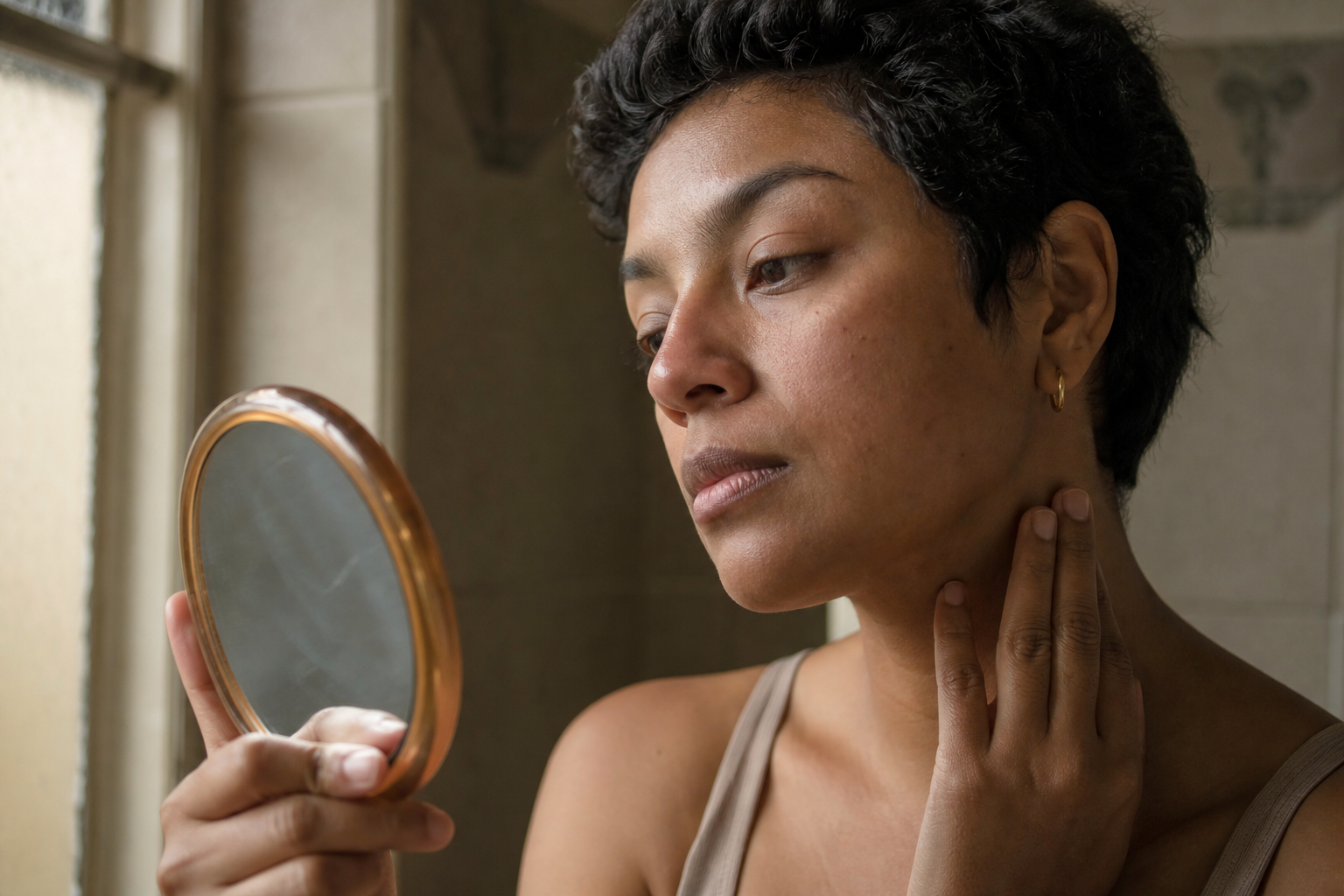
Rosacea hides on a calm day, so your pre-visit record is the diagnosis.
Rosacea's signs appear and resolve, so a visit booked weeks after a flare often captures a calm face. The record you bring matters more than the exam.
The flare is gone by the time you sit down
The flare that pushed you to book the appointment has, three weeks later, gone quiet. You are in the waiting room with skin that looks unremarkable, rehearsing how to describe a burning, blotchy face that is not currently burning or blotchy. The dermatologist will have roughly fifteen minutes [Most dermatology appointments fit into 5-, 10-, or 15-minute blocks, with two or three intervals blocked for new patients. ([source](https://www.dermatologytimes.com/view/follow-these-tips-keep-your-practice-track))], and most of that window captures a face on one of its better days. This is not bad luck. For rosacea specifically, it is the predictable result of how the condition behaves meeting how appointments get scheduled.
Call it the appointment-timing gap
Rosacea's defining clinical feature is that its signs appear and resolve. Flushing, papules, the heat after a hot drink: these are events, not a steady state. A dermatology visit, by contrast, is a single snapshot booked weeks after the moment that prompted it. The two rarely line up. We call this the appointment-timing gap, and once you see it, the standard advice inverts. The decisive diagnostic variable for rosacea is not what happens in the room. It is the record you carry into it.
Why the checklist framing misses the point
Search for what to bring to a dermatologist for rosacea and the answers converge on a checklist: list your products, write your questions, note your family history. All useful, but it treats the visit as an information-transfer problem when rosacea's is an evidence problem. Most skin conditions hold still long enough to be examined. A persistent rash, a suspicious mole, a patch of eczema: they are present when you sit down. Rosacea is one of the few common skin conditions where the thing you need the clinician to see is usually absent at the exact moment they could see it. No amount of preparation fixes that from inside the appointment.
What the literature actually supports
Rosacea has no confirmatory lab test or biopsy; diagnosis is clinical, made from visible features [Rosacea diagnosis is made clinically, based on visible assessment and patient history, after excluding other causes of facial erythema. ([source](https://jcadonline.com/aars-june-2019/))]. In 2017 an international consensus panel (ROSCO) and the National Rosacea Society moved the field away from the older four-subtype model toward a phenotype approach, meaning diagnosis anchored on individual features rather than a named subtype [In 2017, the global ROSacea Consensus (ROSCO) panel recommended transitioning from a subtype to a phenotype approach for rosacea diagnosis. ([source](https://www.dermatologytimes.com/view/phenotype-based-approach-advances-management))]. That shift matters here because it puts the weight on identifying specific features, and the most consequential of those is one patients routinely conflate: persistent erythema versus episodic flushing. Erythema is the background redness that stays, the centrofacial redness present even on a calm day, and it functions as a phenotype marker. Flushing is transient vasodilation, the temporary widening of blood vessels that floods the skin with warmth and color and then fades, often tied to a trigger like heat, alcohol, or stress. Clinicians weigh and treat these differently. A patient who reports that their face is red has said almost nothing about which of the two is in play, and a calm-day exam cannot resolve it either. The gap widens for darker skin: erythema is harder to see against Fitzpatrick IV to VI skin tones, and rosacea is underrecognized in skin of color partly for that reason [Rosacea is often under-recognized or misdiagnosed in patients with skin of color (Fitzpatrick Skin Types IV–VI), per Alexis. ([source](https://www.researchgate.net/profile/Andrew-Alexis-2))]. Adamson & Smith (JAMA Dermatology, 2018) and Daneshjou et al. (2022) documented that the imaging and algorithmic tools meant to help here perform substantially worse on dark skin, which means the in-room snapshot is least reliable for exactly the patients it already underserves.
The pattern, walked through
Consider two patients with the same skin. The first arrives with a mental summary: it gets red, especially when it's bad, maybe a few times a week. The clinician sees calm skin, hears a vague history, and is left to infer. The second arrives with a timestamped photo log: eleven dated images over six weeks, three of them captured mid-flush within an hour of a hot meal, and a record mapping each event to what preceded it. Now the clinician can see persistent central redness in the baseline shots, distinguish it from the post-meal flushing in the timestamped ones, and read a trigger pattern tied to specific events rather than vague categories. Same fifteen minutes. Entirely different diagnostic traction. The trigger record is where this most often goes wrong. Alcohol as a category is nearly useless; two glasses of red wine on the 14th, flushing within twenty minutes, faded by morning is data. The literature on rosacea triggers is itself unsettled, with genuine disagreement over red wine versus white and over the role of Demodex mites [The 2002 NRS survey of 1,066 patients ranked the most common rosacea aggravators, while a separate 2010 NRS alcohol-specific survey of 783 patients found red wine cited as a trigger by 72% and white wine by 49% — a distinction that matters because the two appear to act through different mechanisms (acute histamine response vs. flavonoid effects). Demodex mites show roughly a four-fold higher density in rosacea patients versus controls and respond to acaricidal treatments, but whether they cause rosacea or are a consequence of it remains an open question in the literature.], which is precisely why a personal, event-level record beats a generic trigger list.
What changes if this is right
If the appointment-timing gap is real, the advice changes. For most skin conditions, preparation means showing up informed. For rosacea, it means showing up with evidence the exam itself cannot produce. The pre-visit record stops being a nice-to-have and becomes the part of the diagnosis the clinician cannot work without. That reframes the patient's role entirely: not a passive describer of symptoms after the fact, but the only instrument positioned to capture the condition while it is actually visible. Documentation outside the clinic is structurally necessary for rosacea in a way it simply is not for a condition that holds still.
Building for a condition that won't hold still
This is the design problem we built Skinframe around. Rosacea asks the patient to be a longitudinal recording device, and most tracking tools were not built for that. Some still ask which subtype you have, a question the field retired in 2017. Some collapse severity into a single composite number that hides the per-feature detail a clinician actually reads. Some lean on face-scanning the equity literature says you should not trust on darker skin. We took the opposite read of the evidence. Skinframe keeps timestamped photos and trigger events on-device, logs features separately instead of flattening them into one score, and is built so the record you carry into the appointment is the structured one the exam-room snapshot can never be. We do not diagnose anything and we do not claim to. We make the evidence legible.
What we're watching
We are watching how the phenotype framework continues to filter into routine practice, and whether the skin-of-color recognition gap narrows as the 2017 consensus ages and gets revisited. Until the in-room snapshot can capture a condition that refuses to hold still, the record you keep between visits is the part of the diagnosis that is genuinely in your hands. Bring it, and talk to your dermatologist about what it shows.
Walk into your next appointment with a timestamped record your dermatologist can actually read. See how Skinframe captures rosacea between visits.
Evidence in adjacent dermatology conditions like atopic dermatitis and psoriasis shows that patient-reported tracking improves visit outcomes; Skinframe applies the same approach to rosacea, with timestamped photos and trigger events kept on-device. We built it because rosacea, more than most skin conditions, is diagnosed from a record the appointment cannot generate on its own.