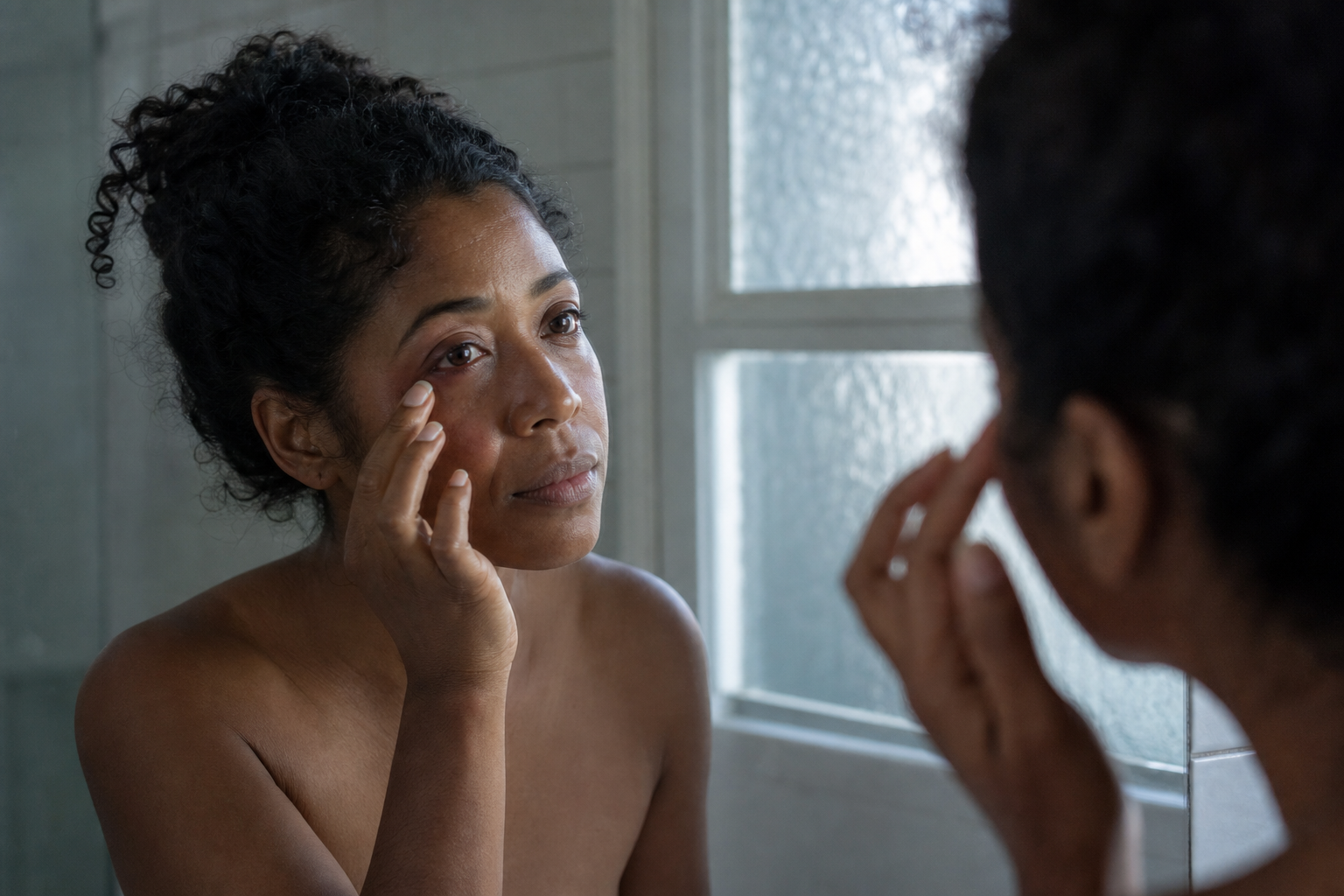
Ocular rosacea: right condition, wrong specialist, no bridge
Eye symptoms affect most rosacea patients and sometimes arrive first, but the specialty split means two doctors treat half the condition each, with no shared record between them.
Six months of eye drops for the wrong diagnosis
The artificial tears were not working. Half a year of drops, a dry-eye diagnosis from the optometrist, and the grittiness still arrived every morning like sand caught under the lids. What no chart connected: the same person had spent two years treating facial flushing with a dermatologist, in a separate file, in a separate building. The eye doctor never saw the rosacea history. The dermatologist never saw the eye exam. Two specialists, each managing half of one condition, neither holding the other half.
If you searched "ocular rosacea what doctor to see," you are already past the part where someone tells you rosacea can affect your eyes. You know. The harder question is who actually owns the problem, and the honest answer is that nobody fully does.
The routing gap
Here is the thesis, and we will call it the routing gap. Rosacea of the eyes (ocular rosacea, the inflammation that shows up as burning, grittiness, watering, and recurring styes) is managed by ophthalmologists and optometrists. Rosacea of the skin is managed by dermatologists. The condition does not respect that line. The patient lives on both sides of it. The medical record does not.
So people end up treating the two halves in parallel for years, with no shared timeline showing that the eye flares and the skin flares rise and fall together. The drops chase symptoms. The creams chase symptoms. Neither doctor sees the pattern the other is looking at, because there is no single page where both patterns live.
Why "did you know rosacea affects your eyes?" is the wrong article
Most writing on this topic opens with a reveal: did you know rosacea can affect your eyes? That article is written for someone who has not connected the dots yet. The person typing the eye-doctor question into a search bar has connected them. They are not missing the awareness. They are missing the path.
The awareness framing also quietly misleads, because it suggests the eye involvement is a late, secondary complication of the skin disease. For a meaningful share of patients it is not secondary and it is not late. It comes first, before a single visible bump or flush, which is exactly the scenario where the routing fails hardest: there is no skin diagnosis yet to connect the eye symptoms to.
Does rosacea cause dry eyes? What the numbers say
The eye involvement is not a rare footnote. A 2025 review (PMC11872267) puts ocular rosacea at roughly 58 to 72 percent of rosacea patients, meaning eye symptoms are closer to the rule than the exception. In about one in five cases, those eye symptoms appear before any skin symptoms at all.
The mechanism is the piece most patients, and many dermatologists, never see documented. The same review found 85 percent of ocular rosacea patients have blocked meibomian glands, the oil glands lining the edge of the eyelid that keep tears from evaporating too fast. When they clog, the eye reads as dry even though tear production may be fine, which is why pure artificial tears so often underperform. A dry-eye label is frequently the right symptom and the incomplete cause.
58-72%
of rosacea patients have eye involvement (ocular rosacea)PMC11872267, 2025 review
~20%
of cases where eye symptoms appear before skin symptomsPMC11872267, 2025 review
85%
of ocular rosacea patients have blocked meibomian (eyelid oil) glandsPMC11872267, 2025 review
A dry-eye diagnosis is not the end of the question
If artificial tears are not holding and you have any rosacea history, ask whether meibomian gland dysfunction is part of the picture. It is the oil-gland mechanism behind most ocular rosacea, and it is treated differently from a simple tear-volume problem.
What kind of doctor do you see for ocular rosacea?
Both. That is the answer the split makes awkward, so here is the practical division. Your dermatologist owns the skin disease and the trigger story. Your eye doctor (an ophthalmologist, or an optometrist who handles ocular surface disease) owns the eyelid exam, the meibomian glands, and the surface of the eye. Neither alone owns the connection between them, which is the part that decides treatment.
Skin tone changes where the first clue shows up. On deeper skin, facial redness is harder to see, and both diagnostic tools and clinician training underperform on darker skin (Adamson & Smith 2018; Daneshjou 2022). For a patient with Fitzpatrick IV to VI skin, the gritty, burning eyes can be the earliest visible sign, arriving with no obvious skin flag to route them toward a rosacea workup at all.
Take this to your dermatologist
Take this to your eye doctor
Flushing, bumps, visible facial redness
Gritty, burning, or watering eyes that come and go
Your trigger log: heat, alcohol, sun, stress
Recurring styes or crusting along the lash line
Full rosacea history and what you have tried
An eyelid exam for blocked meibomian (oil) glands
A photo timeline of your skin flares
Whether eye flares rise and fall with skin flares
The split-specialty routing map. The bottom row is the one neither doctor can answer without the other's record.
The bridge nobody built
Change the record and you change the routing. The reason patients spend years in parallel treatment is not that the doctors are careless. It is that each one is reasoning from half the data. The dermatologist cannot see that the eye grittiness spikes the same week as a wine-and-sun flare. The eye doctor cannot see that the flushing log already named the trigger.
A single flare timeline both clinicians can read collapses that gap. Not a new diagnosis, not a new prescription, just the same evidence sitting in one place: when the skin flared, when the eyes flared, what preceded both. That is the work Skinframe is built to hold, one log of dated, on-device photos and symptom notes you can bring across the hallway, so the eye history and the skin history finally sit in the same chart you control. If your eyes are gritty and your rosacea history is real, take both to both doctors, and bring the record that connects them.
You are in the right place. You are just talking to the wrong specialist, and no one built the bridge.
Keep one flare log your dermatologist and your eye doctor can both read. Join the Skinframe waitlist.
Skinframe keeps your skin and eye history as one dated, on-device timeline, the shared record the split-specialty gap leaves out. Photos and notes stay on your phone; you decide which doctor sees what.