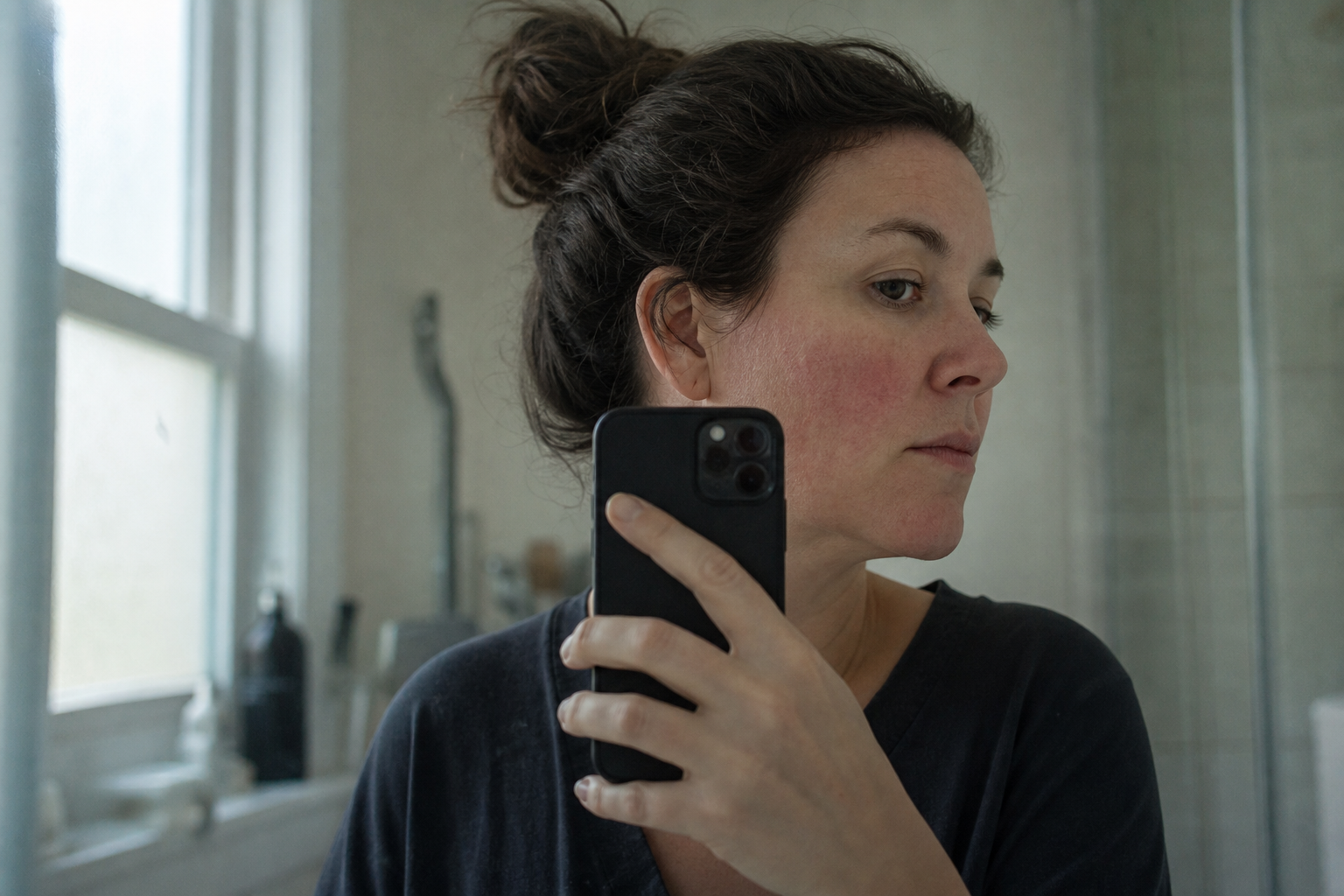
Everyone says keep a rosacea diary. Nobody says how to keep one.
Every clinical authority recommends documenting your rosacea before treatment. None of them specify the documentation standard a dermatologist can actually read. Here is what that standard looks like.
The gallery problem
You are in the chair. The dermatologist asks to see how your skin has been, and you hand over your phone, already scrolling to the photos you saved on the worst days. A blotchy cheek under a restaurant's warm light. A close-up taken at arm's length in your car. A flush you caught in the bathroom mirror three weeks ago. They are real, and they are useless. Not because the rosacea is not there, but because no two of them were taken the same way. Different light, different distance, different time of day, no record of what came before each one. What you have is a collection of worst moments. What a dermatologist needs is a record they can compare against itself. Those are not the same thing, and almost nobody tells you that until you are already sitting in the room.
The thesis: documentation has a standard, and it was never written down
Search for how to document rosacea before a dermatology appointment and you get the same instruction from every credible source: keep a diary, track your triggers, take photos. We call the thing they leave out the missing standard. Because documentation is not a habit, it is a method. A photo is only evidence if it was captured under conditions consistent enough to compare to the next one. A trigger note is only signal if the same fields are logged every time, flare or no flare. The advice to document treats the output (a diary, a photo) as the goal. The actual goal is a record built to a standard, and the standard, the part that makes any of it usable, is the part no one specifies.
Why "just keep a diary" quietly fails
The reason the generic advice fails is that it optimizes for the wrong reader. A diary you keep for yourself rewards drama: you reach for the camera when your skin looks alarming, because that is when you feel the urge to record. But pattern recognition, the thing a clinician is actually doing, needs the boring days too. A baseline you cannot see your flares against is not a baseline. Worse, rosacea presentation is not one thing. Since the dermatology field reorganized its assessment around phenotypes (individual visible features, such as persistent redness, bumps and pus-filled spots, and visible blood vessels) rather than rigid subtypes, what matters is how each feature changes over time. A folder of full-face photos taken under random light cannot show that. The advice to document, without a standard, produces exactly the artifact that cannot answer the question it was collected to answer.
What the sources actually say (and stop saying)
We read the top results for the queries patients use before an appointment. National dermatology bodies, large medical-reference sites, and primary-care references converge on the same recommendation to track flares, photograph the skin, and note possible triggers. Where every one of them stops is identical: not one specifies the photo conditions, the cadence, or the format. Patients notice. In rosacea and skincare communities, the recurring question is not whether to document but how, and the answers people improvise (camera-roll folders, screenshots, notes apps) are workarounds for a standard that was never handed to them. In an r/TheGirlSurvivalGuide thread (post 1syvpn1, 27 upvotes, 23 comments), patients searching for a dedicated rosacea tracking app found none and landed on improvised substitutes: Apple Photos plus a Notes app (the most-recommended workaround, with documented retention failure — 'I tried using a notes app for this and gave up after a week'), generic journaling apps where users had to 'build the trigger tracking yourself,' and mood-tracking apps repurposed to log skin state. Community members characterized purpose-built symptom diary apps as 'designed for pain or chronic illness, not for something as visual and pattern dependent as facial redness — square peg into a round hole.' The disagreement in the literature is about triggers themselves (whether red wine differs from white, how much demodex matters), not about whether consistent documentation helps. That part is settled and unspecified at the same time.
The standard, walked through one flare week
Here is what a usable record looks like in practice. Monday, no flare: you photograph your face anyway, in the same spot by the same window, phone at the same distance, in the morning before products. That is your baseline. Wednesday your cheeks burn after a hot shower and a stressful call; you capture under the same conditions and log three fields that carry clinical signal: what you ate and drank, your temperature exposure (the hot shower, the warm room), and a one-word note on stress. You skip the fields that are noise for most people, like the brand of moisturizer you have used unchanged for a year. Friday it has calmed; you capture again. Across the week, the clinician can now see the same face, same light, moving from baseline to flare to recovery, with the context attached to the day it happened. That is pattern recognition material. The same three photos pulled from your camera roll, taken under three different lights with no context, are three anecdotes.
What changes when the record is built to a standard
If the missing standard is the real problem, then the fix is not trying harder to remember to document. It is changing what documentation captures. The appointment changes first: instead of narrating your skin from memory (and memory over-weights the recent and the dramatic), you hand over a record that shows change over time against a stable baseline. The trigger hunt changes too. A coincidental flare looks like a real trigger when you only photograph bad days; it dissolves when the baseline days are in the record beside it. And the burden shifts in the right direction. The work moves from remembering to capture, which is unreliable, to capturing the same way each time, which is a method you can actually keep. The reader who arrives with that record is a different patient to work with than the one with a gallery of worst moments.
Building for the standard, not the gallery
We built Skinframe because this gap is structural, not a personal failing of the people landing in it. The hard part of documentation is not motivation, it is consistency, and consistency is exactly the part software can hold for you: a fixed framing guide so each photo is taken at the same distance and angle, a lighting cue so erythema (redness) is comparable across days, a timestamp, and a context log that captures the few fields that matter clinically without burying you in noise. We do not run a skin-scan or tell you what you have; the dermatology equity literature, Adamson & Smith 2018 and Daneshjou 2022, documents that deployed skin-analysis models fail harder on darker skin, and we will not ship that Adamson & Smith JAMA Dermatol 2018 and Daneshjou et al. 2022 are both cited together as references on AI dermatology health disparities. ([source](https://scholarshare.temple.edu/bitstreams/3d2b421d-d207-475e-993e-316adedaec17/download)). Photos are evidence you and your dermatologist read together, captured to a standard, and kept on your device. The honest version of the efficacy claim: in adjacent dermatology conditions like atopic dermatitis and psoriasis, patient-reported tracking has been shown to improve what happens in the visit Research in adjacent chronic skin conditions shows that mobile self-management and patient-reported tracking produce clinically meaningful improvements in validated symptom and quality-of-life scores; a 2024 systematic review and meta-analysis of over 1,000 atopic dermatitis patients found significant improvements in both disease severity and daily-life impact measures. The repo explicitly frames this as the closest available evidence base for rosacea tracking apps, since no rosacea-specific randomized controlled trial has yet been published., and we are applying the same approach to rosacea.
Skinframe is coming to iPhone: consistent capture, a context log built for your dermatologist, and your photos kept on your device. Join the waitlist to be first in when it ships.
The reader here is doing real homework: a dermatologist told them to document before treatment, and they are trying to do it right. The whole article hands over the standard the clinical sources leave out, with no skin-scan and no diagnosis. That is the proof, the documentation problem is solved on the page first, and the product is simply the most consistent way to keep the record.