Fragrance-free is a claim about one word, not your whole label
On a US label, 'fragrance-free' only means no ingredient called 'fragrance.' Essential oils and masking agents slip through under their own names, and your flare log never sees them.
The label said fragrance-free. Your cheeks disagree.
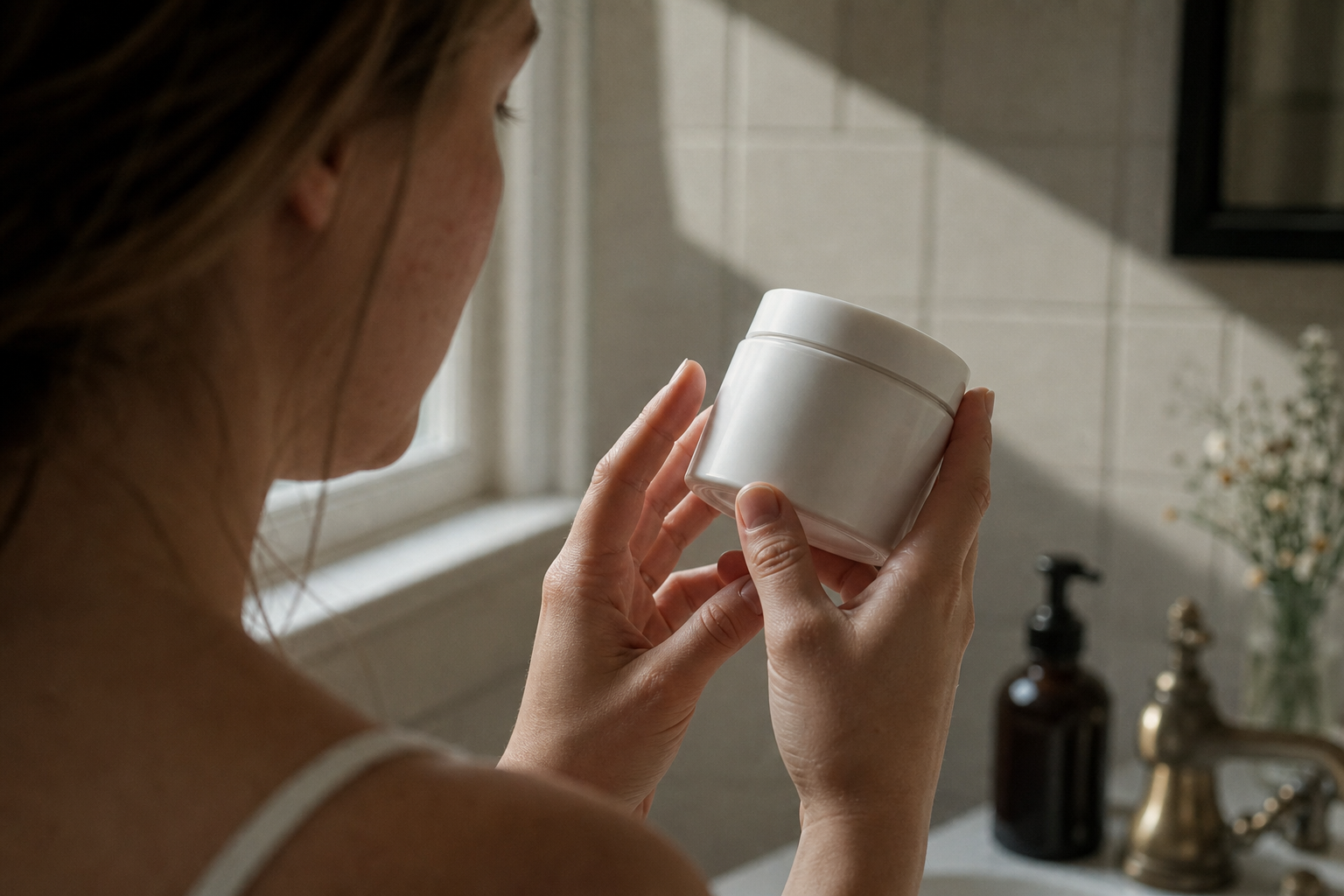
The moisturizer said fragrance-free. You bought it because a dermatologist told you fragrance is one of the most common rosacea triggers, and you did the work: read the front of the jar, saw the claim, brought it home. Three weeks later the burning is back across both cheeks. You turn the jar over and there it is, sixth ingredient down: linalool. Then limonene. Then a botanical extract you can't pronounce. None of those counted as fragrance under the rules, so none of them broke the promise printed on the front. You eliminated the word. The molecules stayed.
The umbrella-term gap
Here is the thesis, and it deserves a name: the umbrella-term gap. On a US cosmetic label, fragrance-free is a claim about one word, not about a category of molecules. The word is 'fragrance,' the single catch-all term the FDA lets a manufacturer use to hide an entire scent compound without naming its parts. Take that compound out and you have earned the fragrance-free claim, even if you then add three individually listed botanical extracts and a masking agent that are, chemically, fragrant. The gap is not a loophole someone is exploiting in bad faith. It is baked into how the label is allowed to be written, and almost no rosacea patient has ever seen it explained in one place.
Why 'fragrance-free equals safe' falls apart
Most rosacea guidance stops at three words: avoid added fragrance. It is good advice and it is incomplete, because it treats the label claim as a guarantee about your skin's exposure. A fragrance-free product can still carry linalool, limonene, citronellol, or benzyl alcohol, listed by their own names, contributed by essential oils or plant extracts rather than by a 'fragrance' blend. Linalool and limonene are notable here: on exposure to air they oxidize into compounds that are among the more frequently flagged contact allergens in patch-test data (Patch testing of consecutive dermatitis patients found contact allergy prevalence rates of 7.0% for oxidized linalool and 5.1% for oxidized limonene. ([source](https://onlinelibrary.wiley.com/doi/full/10.1111/cod.13980))). The claim on the front was truthful. The exposure it implied was not the exposure you got.
What the regulations actually require
The disclosure rules split sharply across the Atlantic, and that split is the whole story. In the United States, the Fair Packaging and Labeling Act lets a manufacturer collapse a scent blend into the single word 'fragrance,' and the FDA has stated plainly that it defines neither 'fragrance-free' nor 'unscented,' so both are marketing terms rather than regulated ones (US FDA cosmetics labeling guidance). The European Union went the other direction: it requires named fragrance allergens to be declared individually on the label, and its 2023 update expanded that named-allergen list from 26 to more than 80 (Regulation (EU) 2023/1545; EU Regulation 2023/1545 adds 56 new fragrance allergens to the labeling list, with requirements applying from 31 July 2026. ([source](https://informait.com/news/cosmetics-fragrance-allergens-2026))). Same ingredient, same jar, two very different amounts of truth on the back panel depending on which side of the ocean it was printed for.
Labeling question
United States (FDA)
European Union
Must individual fragrance allergens be named?
No, 'fragrance' covers them as one term
Yes, 80+ named allergens declared individually
Is 'fragrance-free' legally defined?
No FDA definition; it is a marketing claim
No single definition, but allergen disclosure still applies
Can an essential oil appear without the word 'fragrance'?
Yes, under its own INCI name
Yes, but any named allergen it contains is still flagged
US FDA cosmetics labeling guidance vs Regulation (EU) 2023/1545. The same jar carries different disclosure depending on where the label was printed.
'Unscented' is often the opposite of fragrance-free
Unscented frequently means a masking fragrance has been added to cancel out the raw smell of the base ingredients. So a product can be labeled unscented and contain more fragrant compounds than a fragrance-free one (Unscented products may contain masking agents that can be problematic for individuals with fragrance allergy, per the American Contact Dermatitis Society. ([source](https://www.facebook.com/groups/SensitiveSkinSupport/posts/1198208478245723/))).
Reading a label the way a dermatologist reads it
Walk it through on a real bottle. The front says fragrance-free. You flip to the ingredient list, which is ordered roughly by concentration, and you scan past the water, glycerin, and emollients into the back third where the actives and additives live. That is where the fragrant molecules hide: an essential oil listed as, say, lavandula angustifolia oil, or the isolated terpenes linalool and limonene sitting on their own lines. None of them is the word 'fragrance,' so none of them contradicts the front. If your skin reacts to that class of molecule, the label gave you no warning, and worse, it gave you false confidence. The patient who has already eliminated 'fragrance' and still flares is left staring at a product they were told was safe, with no vocabulary for what actually hit them.
What this does to your trigger data
For anyone documenting patterns before or during treatment, this is where the labeling gap turns into a data-quality problem. Trigger tracking only works if the thing you log matches the thing that caused the flare. If your only category is 'fragrance,' you will mark a fragrance-free product as fragrance-free, log a flare the next day, and record a contradiction you can't resolve. The real culprit, a named terpene four ingredients down, has no place to live in your log. Over weeks, that single blind spot quietly poisons the correlation: the product you trust keeps clearing your own filter, so the pattern never surfaces. You are not tracking your triggers. You are tracking the marketing claims on your triggers.
Logging the ingredient, not the adjective
We built Skinframe around a small, stubborn conviction: the loggable unit for a rosacea trigger should be the actual ingredient, not the adjective on the front of the box. If a flare follows a product, you should be able to attach the specific molecule you suspect, linalool, a named botanical extract, a masking agent, so the correlation survives even when the label calls the whole thing fragrance-free. Evidence in adjacent dermatology conditions, atopic dermatitis and psoriasis, shows that structured patient-reported tracking improves what happens in the exam room; we are applying that same approach to rosacea rather than claiming a rosacea-specific trial we don't have (Patient-reported outcomes in psoriasis include measures of itch, sleep disturbance, and quality of life, reviewed across 260 papers. ([source](https://touroscholar.touro.edu/nymc_fac_pubs/253/))). The point is not a longer ingredient glossary. The point is a log that can finally see what your label was allowed to hide.
You are not tracking your triggers. You are tracking the marketing claims on your triggers.
What we're watching next
The disclosure gap is closing, slowly, in one direction only. The EU's expanded named-allergen rules phase in over the next few years, which means the same global brands will print more honest back panels for European shelves while US labels stay under the umbrella term. We are tracking whether any of that added disclosure crosses back into US formulations voluntarily, and whether the contact-dermatitis literature keeps flagging oxidized terpenes as fast as reformulations add them. None of this is a substitute for medical advice. If a product you were told was safe keeps triggering you, bring the actual ingredient list to your dermatologist and ask them to read the back panel with you. That conversation is the one the front of the box was never going to have.
Skinframe is coming to iPhone. Join the waitlist and we'll tell you the day it lands, so you can start logging what your labels won't.
We read the cosmetic labeling regulations and the contact-dermatitis literature before we wrote a line of logging code. The umbrella-term gap is exactly why Skinframe treats a specific ingredient, not a marketing category, as the thing you log against a flare.